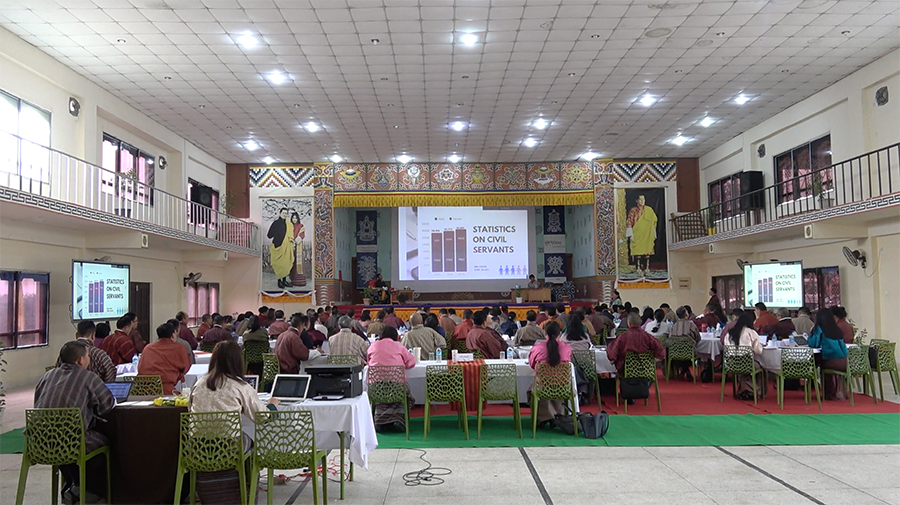
 The Royal Civil Service Commission (RCSC) says the civil service attrition rate has dropped to about six per cent. However, staff shortages continue to affect service delivery. The issue was highlighted today at the annual Executive Forum underway in Gelephu, which brought together around 100 agency heads from across the country.

Opening the forum, the RCSC Chairperson said Bhutan’s civil service has recovered to its pre-COVID strength of about 31,000 employees. However, she noted that voluntary resignations, particularly among young and mid-career professionals, are affecting continuity and institutional capacity.
According to the RCSC, attrition is highest among civil servants aged 27 to 35, especially in specialised sectors such as ICT, health, and engineering, where demand remains strong.
While the attrition rate has improved from 16 per cent in 2022, frequent staff turnover continues to increase training costs, create staffing gaps, and place added pressure on remaining employees.
Against this backdrop, the annual Executive Forum is seen as a key platform for discussing long-standing challenges and charting solutions.
“This year, the theme is leading as one and delivering as one. Where all the heads of agencies come together, and they have their own different and unique mandates. But the common goal is to firstly fulfil His Majesty’s aspirations, then help achieve the government’s priorities, and most important of all to fulfil the needs and expectations of the citizens, enriching the quality and efficiency of services to the citizens,” said Jigme Norbu, HR Officer, RCSC.
On reforms, the RCSC outlined measures to make recruitment more responsive and cost-effective, including waiving preliminary exams for clinical professionals and reprioritising vacancies to better manage attrition.
Greater emphasis is also being placed on competency-based training, professional development, and stronger performance management systems.
The Commission also shared plans to introduce a Performance-Based Variable Incentive (PBVI), which has received principal approval under the latest Pay Revision Act. However, the proposed budget for the 2025–2026 fiscal year was not approved due to fiscal constraints. The PBVI is intended to give agencies greater flexibility in rewarding performance, including adjusting bell-curve distributions based on actual outcomes.
The two-day Executive Forum concludes tomorrow and is expected to generate concrete ideas to improve retention, strengthen capacity, and advance the transformation of Bhutan’s civil service under the Diamond Strategy.
Passang Dorji & Karma Wangdi, Gelephu